The Terminal Ceiling of Open-World Design
The Grand Theft Auto franchise serves as a definitive historical record of the modern, screen-bound video game paradigm. Across its evolution from experimental 2D origins and the revolutionary 3D template of Grand Theft Auto III, through the prolonged commercial hegemony of Grand Theft Auto V, to the hardware-constrained pinnacle of Grand Theft Auto VI, the series demonstrates that traditional, peripheral-driven open-world design has reached its terminal ceiling. As raw computational power yields diminishing experiential returns when mediated through controllers and flat displays, the future of interactive media demands a fundamental transition toward biometric integration, neural interfaces, and direct sensory immersion.
Industrial History and Market Saturation
The Grand Theft Auto franchise exemplifies the medium’s transition from experimental novelty to absolute cultural hegemony. In its nascent 2D iterations, the series established basic mechanics of illicit progression within restricted top-down environments. However, the seismic shift to three dimensions in Grand Theft Auto III codified the modern interactive template. This pivot instituted a permanent loop of urban exploration, systemic crime, and player consequence, a formula that subsequent entries, notably Vice City and San Andreas, scaled without altering its foundational mechanics.
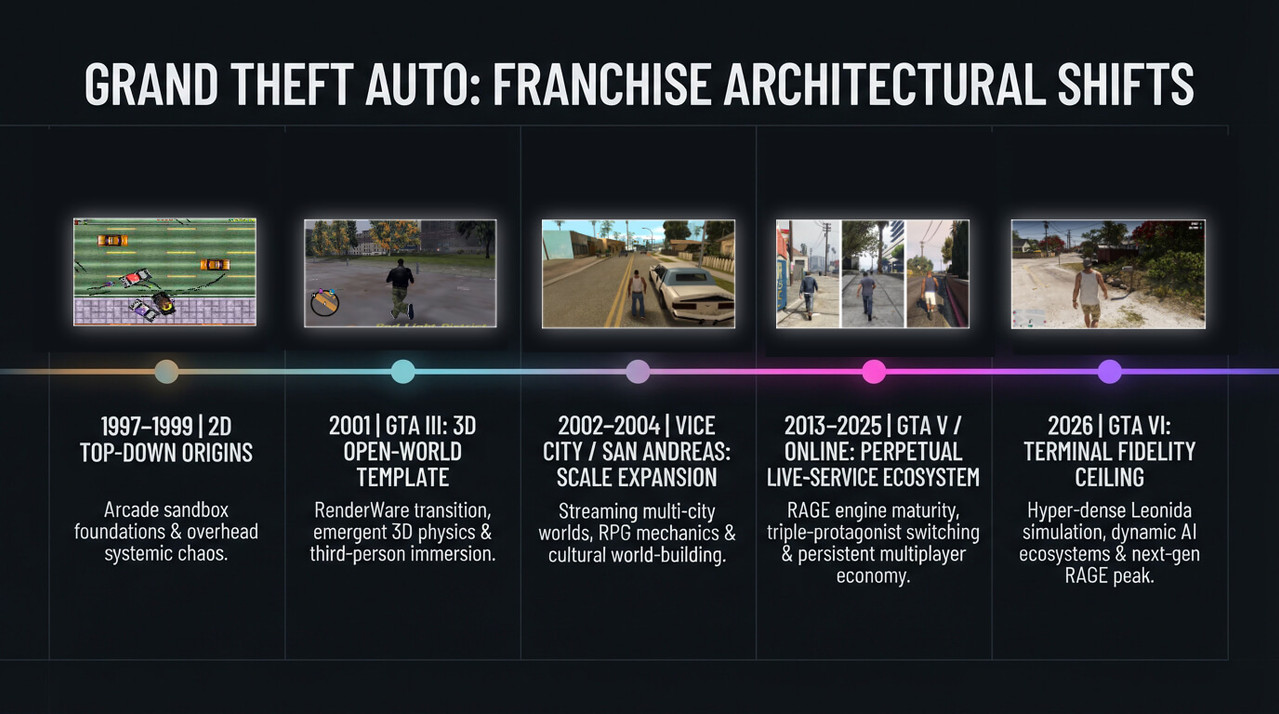
Progression of the Grand Theft Auto formula from early 2D mechanics and 3D urban simulation to live-service saturation and hardware-constrained photorealism.
This prolonged viability culminated in Grand Theft Auto V. By deploying a multi-generational release strategy paired with a perpetual live-service model, the title demonstrated how interactive entertainment could transition from a finite narrative product into a self-sustaining commercial ecosystem. The introduction of GTA Online suspended standard industrial cycles, proving that consumer demand could be indefinitely captured through continuous content delivery. Yet this operational triumph established a baseline of market saturation, creating an environment where publisher restraint became the primary strategy for preserving brand equity.
Hardware Ceilings and the Terminal Peak of GTA VI
The immense commercial triumph of Grand Theft Auto V established an unprecedented paradox: the very cultural dominance that guarantees massive returns simultaneously constrains genuine creative evolution. Within traditional game development cycles, the pressure to surpass a billion-dollar predecessor forces studios to double down on established mechanics rather than risk deep reinvention. Consequently, development priorities shift from pioneering new interactive paradigms to managing the crushing weight of consumer expectation. This dynamic exposes a definitive technical ceiling, a threshold where expending vast computational resources to simulate denser, more photorealistic urban environments yields diminishing returns in actual player agency.
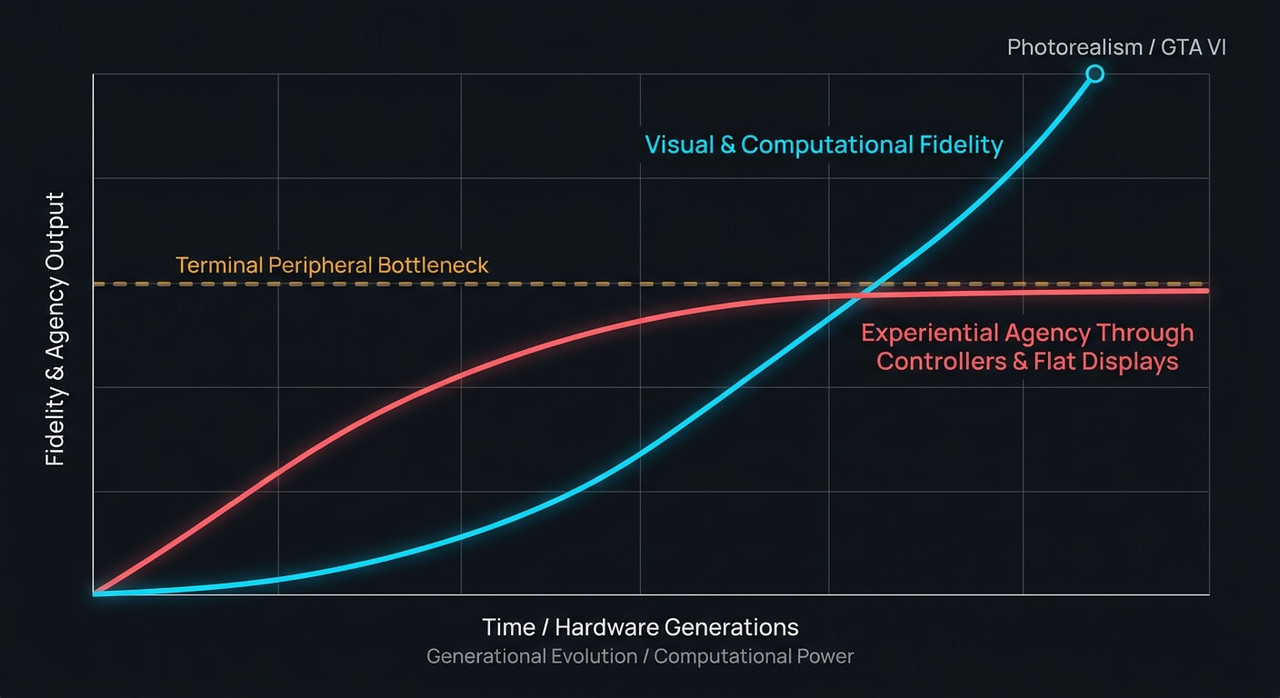
As graphical fidelity approaches photorealism, physical controllers and flat screens create an input-output bottleneck that limits further experiential gains.
Grand Theft Auto VI embodies the terminal peak of this traditional development paradigm. While hardware advancements enable unprecedented fidelity, evidenced by intricate crowd simulations, hyper-realistic lighting models, and expansive environmental scale, the underlying interactive grammar remains bound by the limitations of screen-based, peripheral-driven input. The controller and the flat display act as persistent physical bottlenecks, mediating and flattening the player's connection to the virtual space. As physical silicon approaches theoretical limits in transistor density and thermal dissipation, raw computational brute force can no longer mask the stagnation of the core gameplay loop. Simulating a city with near-indistinguishable visual accuracy ultimately highlights the artificiality of interacting with it through thumbs and glass, marking the absolute saturation point of the current medium.

Close-up photograph in dark lighting of hands holding a game controller in front of a glowing monitor displaying a dense city street.
Biometric Integration and the Post-Screen Paradigm
The exhaustion of screen-bound, peripheral-driven architecture necessitates a systemic evolution in interactive entertainment: the transition from external simulation to direct sensory integration. Having reached the absolute limits of traditional open-world fidelity with Grand Theft Auto VI, further refinement of polygonal density or frame rates can no longer generate meaningful experiential breakthroughs. The next paradigm shift requires bypassing the mechanical bottlenecks of controllers and flat displays entirely, using biometric feedback and brain-computer interfaces (BCIs) to establish a closed-loop dialogue between the virtual environment and the human nervous system.
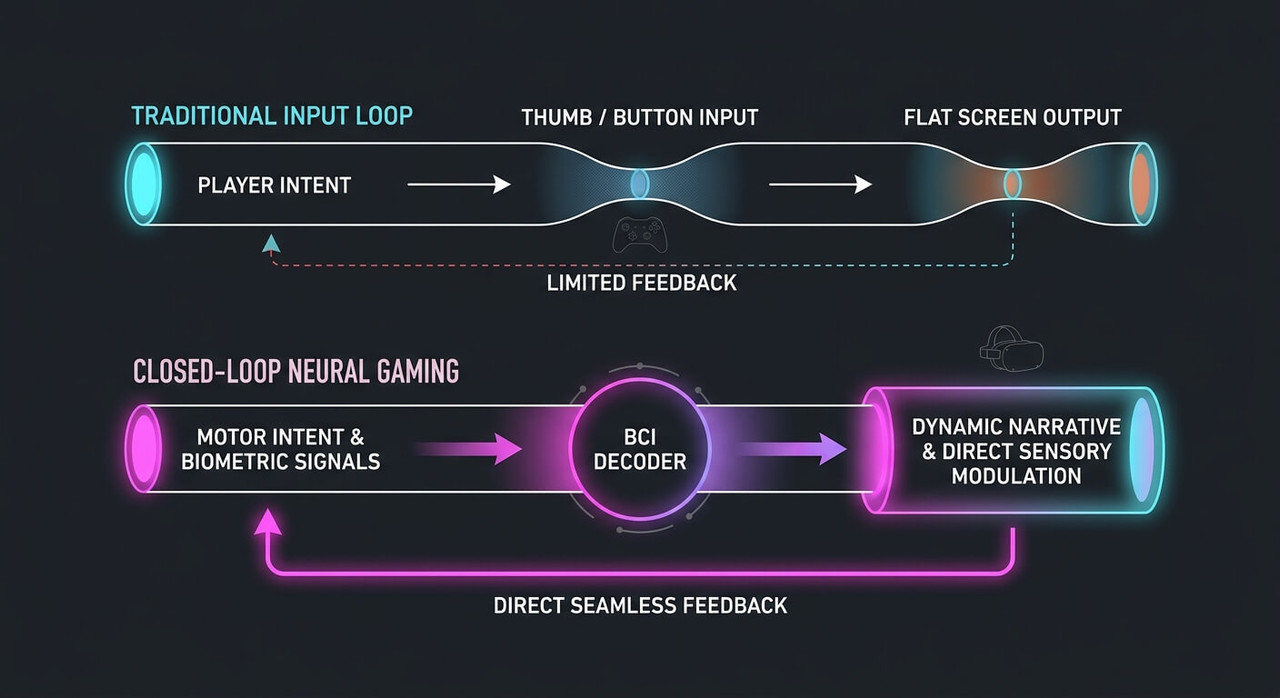
Comparison of traditional controller-and-screen mediation with closed-loop brain-computer interfaces that adapt to motor intent and physiological states.
In this emerging paradigm, immersion is no longer achieved through visual mimicry but through direct neural modulation and real-time physiological adaptation. Rather than translating player intent through physical button inputs, neural interfaces decode motor intentions and emotional states directly, allowing the virtual world to dynamically reconfigure its narrative pacing, environmental tension, and sensory output in response to the user’s cognitive load and biometric signals. Consequently, the traditional gameplay loop, defined by repetitive, pre-scripted mechanics, dissolves into a fluid, responsive experience that mirrors lived perception. As direct sensory integration matures, the screen-bound era exemplified by the Grand Theft Auto franchise will be retrospectively understood not as the pinnacle of interactive media, but as the final, definitive stage of its pre-neural history.
Beyond Thumbs and Glass
The trajectory of Rockstar’s Grand Theft Auto franchise provides a definitive historical record of the modern video game paradigm, from its experimental 2D origins and the revolutionary 3D template of Grand Theft Auto III, through the prolonged market saturation of Grand Theft Auto V, to the hardware-constrained pinnacle of Grand Theft Auto VI. By pushing screen-based simulation to its absolute photorealistic and computational limits, the series inadvertently exposes the diminishing returns of traditional, peripheral-driven design. Once the fidelity of a virtual world outpaces the physical bandwidth of controllers and flat displays, further iterative refinement ceases to advance the medium.
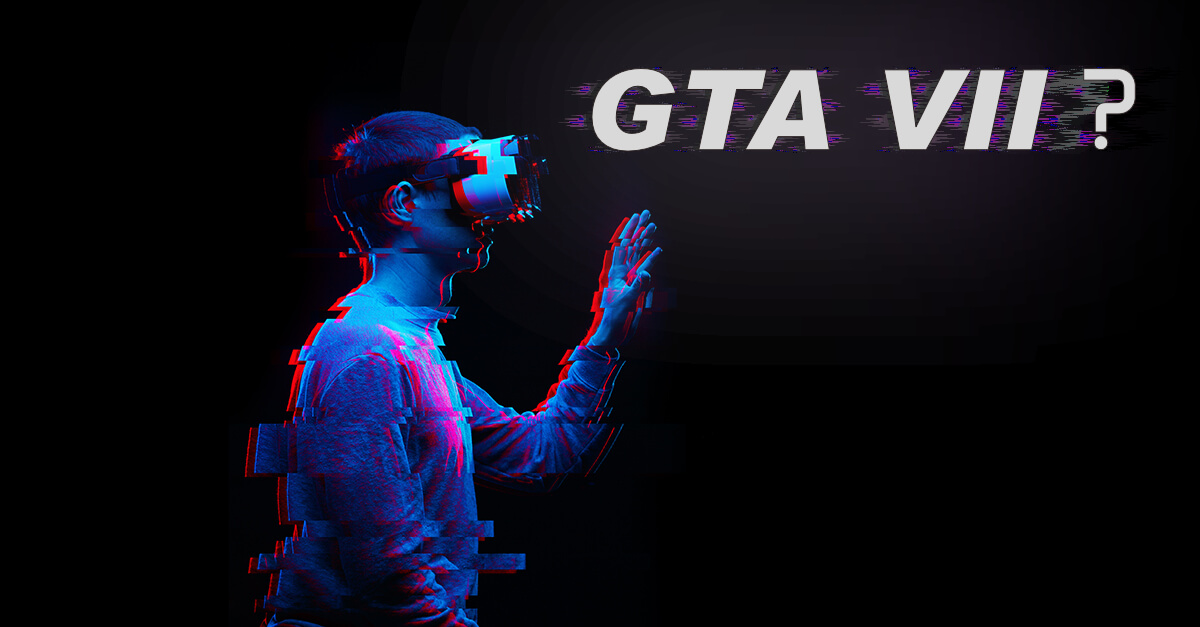
Moving past external visual mimicry toward direct sensory integration reshapes how players inhabit virtual environments.
The exhaustion of the Grand Theft Auto formula signals not the end of interactive entertainment, but its necessary metamorphosis. True experiential evolution now depends on abandoning external visual mimicry in favor of biometric integration and brain-computer interfaces. By establishing a direct, closed-loop dialogue with the human nervous system, the next generation of interactive media will dissolve the barrier between player and simulation, closing the chapter on the screen-bound era and inaugurating the age of direct sensory immersion.
BY RAY MARTENSTYN
ADVERTISEMENT