From Myth-Making to IP Extraction
For decades, the foundational engine of Hollywood rested on a delicate equilibrium between commercial scale and creative intuition. The cultural monuments that defined modern cinema, whether Star Wars, the early Marvel Cinematic Universe, or Pixar’s golden-era catalog, did not emerge from financial spreadsheets or engagement algorithms. They succeeded because they were forged through singular directorial vision, emotional sincerity, and earned audience trust.
In the contemporary entertainment ecosystem, that architecture has been inverted.
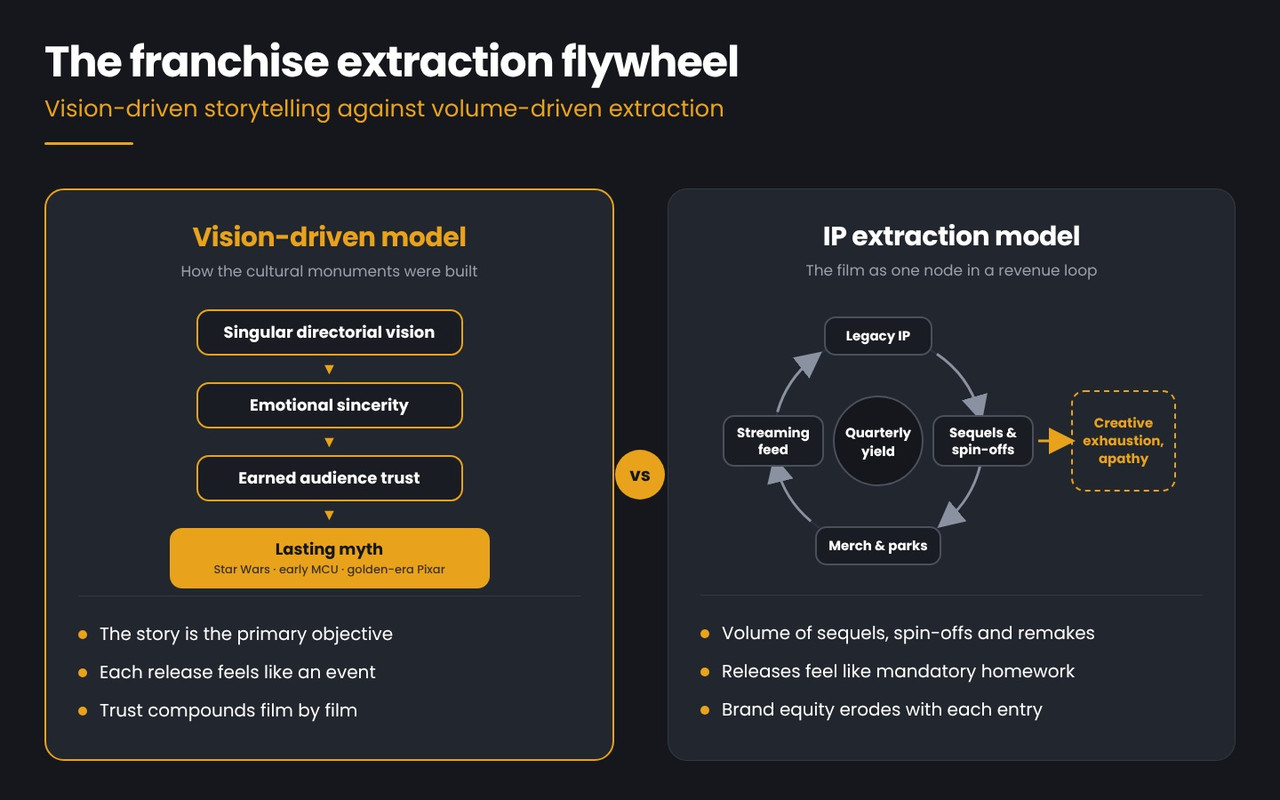
Comparison of traditional creative development against modern conglomerate IP extraction mechanics across theatrical, streaming, and ancillary releases.
Legacy conglomerates have quietly transitioned from cultivating original myths to strip-mining existing trademarks for predictable quarterly yields. When corporate leadership treats a theatrical feature merely as a single data point inside a sprawling merchandise, theme-park, and streaming flywheel, storytelling ceases to be the primary objective. Instead, beloved universes are stretched thin across endless sequels, secondary spin-offs, and premature live-action remakes, producing visible creative exhaustion, hollowed-out mythology, and widespread audience apathy.
The Disney Case Study: Over-Saturation and Creative Miscalculation
No conglomerate illustrates the systemic peril of modern franchise management more starkly than The Walt Disney Company. Commanding an unmatched war chest of cultural pillars across Marvel, Lucasfilm, Pixar, and Walt Disney Animation, the studio has spent recent years demonstrating how rapidly generational brand equity erodes when volume replaces vision.
Even as CEO Josh D’Amaro prepares to deploy roughly $26 billion in content spending for fiscal 2027 alongside a $3 billion annual cost-savings target, the underlying creative tension remains unresolved: capital scale cannot manufacture mythic resonance when the development slate is built on defensive mechanics.

Expanding slates across theatrical releases, streaming libraries, and catalog remakes tests audience selectivity and brand equity.
- Diminishing Returns on Legacy Pillars: By flooding streaming feeds and theatrical calendars with interconnected installments, Disney diluted the sense of event-level rarity that once made its releases cultural imperatives. Viewers have become ruthlessly selective, turning out for trusted comfort properties while rejecting secondary spin-offs and assembly-line entries that feel like mandatory homework.
- The Tyranny of Committee Storytelling: Across both animation and live-action divisions, a string of high-profile creative miscalculations exposed a studio apparatus reliant on risk-averse formulas and rigid internal checklists rather than organic drama. Authentic diversity naturally deepens cinema when driven by a filmmaker’s lived truth. Yet when corporate leadership reduces representation and thematic nuance to bureaucratic compliance metrics, audiences immediately detect the artifice, sensing characters engineered to satisfy boardroom optics rather than human conflict.
- The Retreat to Nostalgia: Rather than incubating new, generation-defining worlds, incumbent studios increasingly retreat into decades-old catalogs and live-action reconstructions. It is a defensive posture that harvests short-term box office spikes while masking a deeper creative insolvency, forcing devoted fans into a trap of compulsory loyalty where watching a beloved myth get flattened feels less like celebration and more like obligation.
The Erosion of Studio Control: Private Capital and Outside Financiers
Compounding these creative missteps is a quiet institutional revolution in how major motion pictures are capitalized. Historically, legacy studios maintained an unassailable competitive moat: exclusive access to balance-sheet liquidity at scale and unilateral control over global distribution. Today, ballooning production budgets, volatile theatrical windows, and massive corporate restructuring have forced traditional gatekeepers to cede ground.
Private equity funds, sovereign wealth vehicles, and independent slate financiers have stepped directly into the breach, underwriting substantial tranches of modern tentpoles and rewriting how recoupment waterfalls operate. While outside capital keeps nine-figure productions moving amid studio consolidation, it fundamentally alters the creative mandate:
- Asset-Class Mentality: Private investors do not underwrite films out of devotion to cinema; they evaluate productions as packaged financial instruments. Senior debt recovery, completion-bond eligibility, jurisdictional tax rebates, territorial pre-sales, and risk-weighted internal rates of return take precedence over artistic legacy.
- Loss of Institutional Autonomy: Because private capital concentrates heavily in sequel-ready collateral and pre-sold brand extensions to mitigate single-project risk, legacy studios lose the creative autonomy they once wielded. Green-lighting decisions are increasingly governed by spreadsheet defensibility rather than directorial conviction, turning studio executives into middle-management administrators servicing outside balance sheets.

Structural overview of how outside slate financing prioritizes financial risk mitigation and sequel-ready collateral in modern tentpole production.
The Generative Horizon: AI and the Commodification of Craft
Simultaneously, the rapid institutionalization of artificial intelligence across Hollywood production lines threatens to accelerate the standardization of blockbuster storytelling. Moving past early industry resistance, major studios now embed AI workflows across pre-visualization, environment generation, localization, and post-production to compress render latency and slash overhead.
As film history has repeatedly demonstrated, from the liquidation of physical negative cutters and chemical lab technicians during the nonlinear editing revolution to today’s closed-loop, artist-driven systems, technology itself is not the enemy of cinema. When deployed as a localized, filmmaker-steered instrument, AI strips away technical overhead and middle-work, collapsing the distance between an artist’s imagination and its material realization.

Generative and post-production tools operate differently depending on whether they serve artist-led craft or automated volume targets.
Inside corporate franchise management, however, the incentive structure runs in the opposite direction. When efficiency becomes the destination rather than the vehicle, conglomerates are tempted to replace idiosyncratic human craftsmanship with effortless machine approximations. Combined with private capital’s demand for predictable, low-risk collateral, unconstrained automated workflows risk trapping tentpole cinema inside a feedback loop of recycled aesthetics, safe nostalgia, and algorithmically smoothed narratives.
The Cost of Breaking Audience Trust
The crisis confronting modern franchises is not a shortage of capital, computational power, or recognizable trademarks. It is a crisis of stewardship.
By allowing financial engineering, prescriptive committee checklists, and automated production shortcuts to dictate the creative process, legacy studios have violated the foundational compact of entertainment: audiences invest their time, money, and emotional lives into stories that feel daring, tactile, and unmistakably human.
Tools mutate, capital arrangements evolve, and technical middle-work continues to evaporate. Yet when the noise clears, no private equity waterfall or generative model can manufacture wonder on its own. Until the industry restores authority to uncompromising storytellers and treats franchises as living myths rather than depreciating assets, the slow liquidation of pop culture’s greatest legacies will continue, leaving only the individual artist standing at the center with the spark.
Long-term franchise value depends on creative stewardship, narrative risk, and audience trust rather than output volume alone.
BY RAY MARTENSTYN
ADVERTISEMENT
